OIO Loop
A pocket diffraction grating in a holder. Look at any light through it and its spectrum spreads into a rainbow, so you can watch OIO pull the blue out at night with your own eyes.
A diffraction grating with 1000 lines per millimetre, in a pocket frame. It ships free in the box with your OIO bulbs so you can see the science with your own eyes on day one.
Shop OIO bulbsScrub an OIO through the day
This is what an OIO bulb looks like through the Loop. Drag from warm to cool and watch the blue cross over.
The bulb is on the left; its spectrum spreads to the right, exactly as the 1000 lines/mm grating throws it. Drag the color temperature from a deep 800K ember up to noon and watch the blue end of the rainbow appear and vanish.
Don't look straight through it
Almost everyone holds the Loop up, looks dead-straight at the bulb, sees just the bulb, and puts it down. That is the zero order — undispersed light, no rainbow.
The spectrum is thrown off to the side, about 25–45° away. Keep the bulb in front of you, look through the Loop, then let your gaze drift to the side (or tilt the Loop) until the rainbow slides into view. It appears on both sides.
What the Loop is
The Loop is a transmission diffraction grating held in a pocket frame. The grating is a film ruled with 1000 parallel lines per millimetre — 1000 microscopic slits packed into the width of a grain of rice. Look at any light through it and that light fans out into its true spectrum, the way a prism splits sunlight, but sharper and in a straight line.
The physics, done properly
With 1000 lines per millimetre, the spacing between slits is d = 1 mm / 1000 = 1000 nm — about twice the wavelength of green light. Each wavelength leaves the grating at an angle set by the grating equation:
d · sin θ = m · λ
where λ is the wavelength, m the order (0, 1, 2…), and θ the angle. Because the angle depends on wavelength, white light spreads out. For the Loop, the first-order (m = 1) spectrum runs from
- violet: sin θ = 400/1000 = 0.40 → θ ≈ 23.6°
- red: sin θ = 700/1000 = 0.70 → θ ≈ 44.4°
Straight ahead (m = 0) the light passes through undispersed — you still see the source itself. Glance just to either side and the same light is spread into its spectrum, violet nearest the source, red farthest out.
What you'll see looking at an OIO
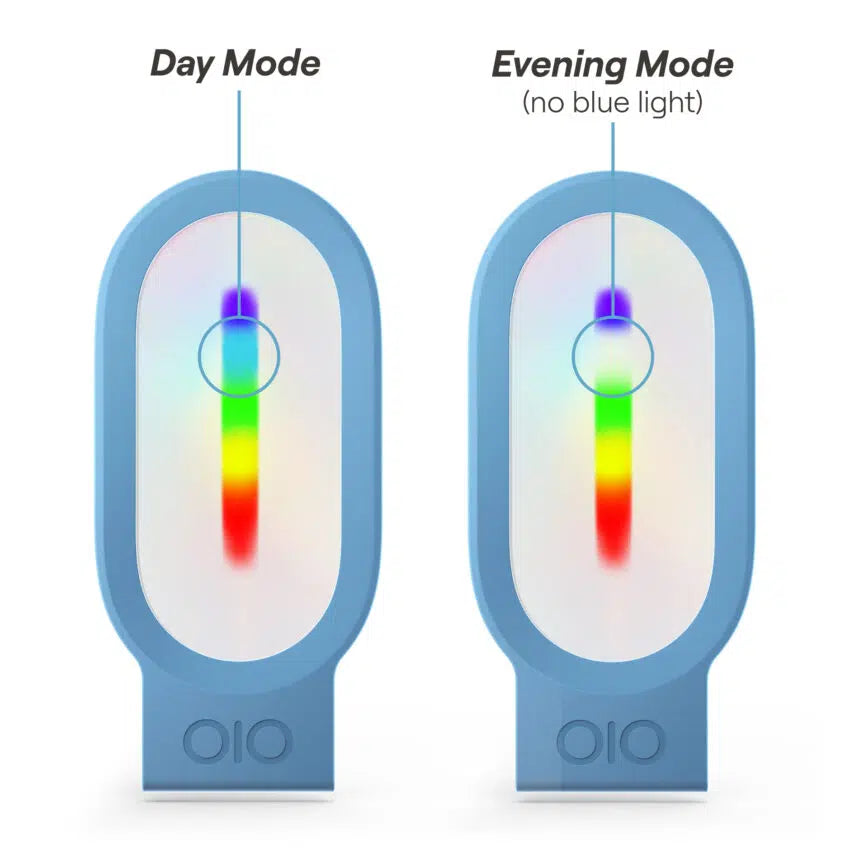
Point the Loop at an OIO bulb and drag the color temperature below. The bulb sits on the left; its rainbow spreads off to the right, violet nearest, red farthest. The shaded band is 440–495 nm — the blue-cyan range OIO tracks, the part your body clock reads most strongly.
How to use it
- 01Hold it upBring the Loop close to one eye, frame facing out.
- 02Find the lightLook through it toward an OIO bulb, or any light source.
- 03Glance to the sideThe light stays put ahead; its rainbow appears off to each side. Tilt slightly to sweep it into view.
- 04Compare day vs nightSwitch your OIO between day and evening in the app and watch the blue end of the rainbow appear and disappear.
Why the missing blue matters
The rainbow is complete, bright from violet through blue to red. That blue-cyan band around 440–495 nm is what the melanopsin cells in your eyes are most sensitive to. It's the recognized input for the circadian system: the light that signals daytime to the body clock.
OIO reshapes the spectrum so almost nothing lands in that 440–495 nm band. Through the Loop, the blue end simply goes dark, leaving a warm violet-to-red rainbow. Your eyes still see a comfortably lit room, while the band the clock reads is nearly empty.
The crossover happens between 3000K and 4000K, the same handoff OIO makes every evening as it walks your light down from bright day to a blue-free ember. The Loop lets you watch it happen: the same white light to your eye, a very different amount of light in the one band your clock reads. That is the whole idea, and you can hold it in your hand.