Is blue light bad at night, and how do you reduce it?
Updated 2026-07-04
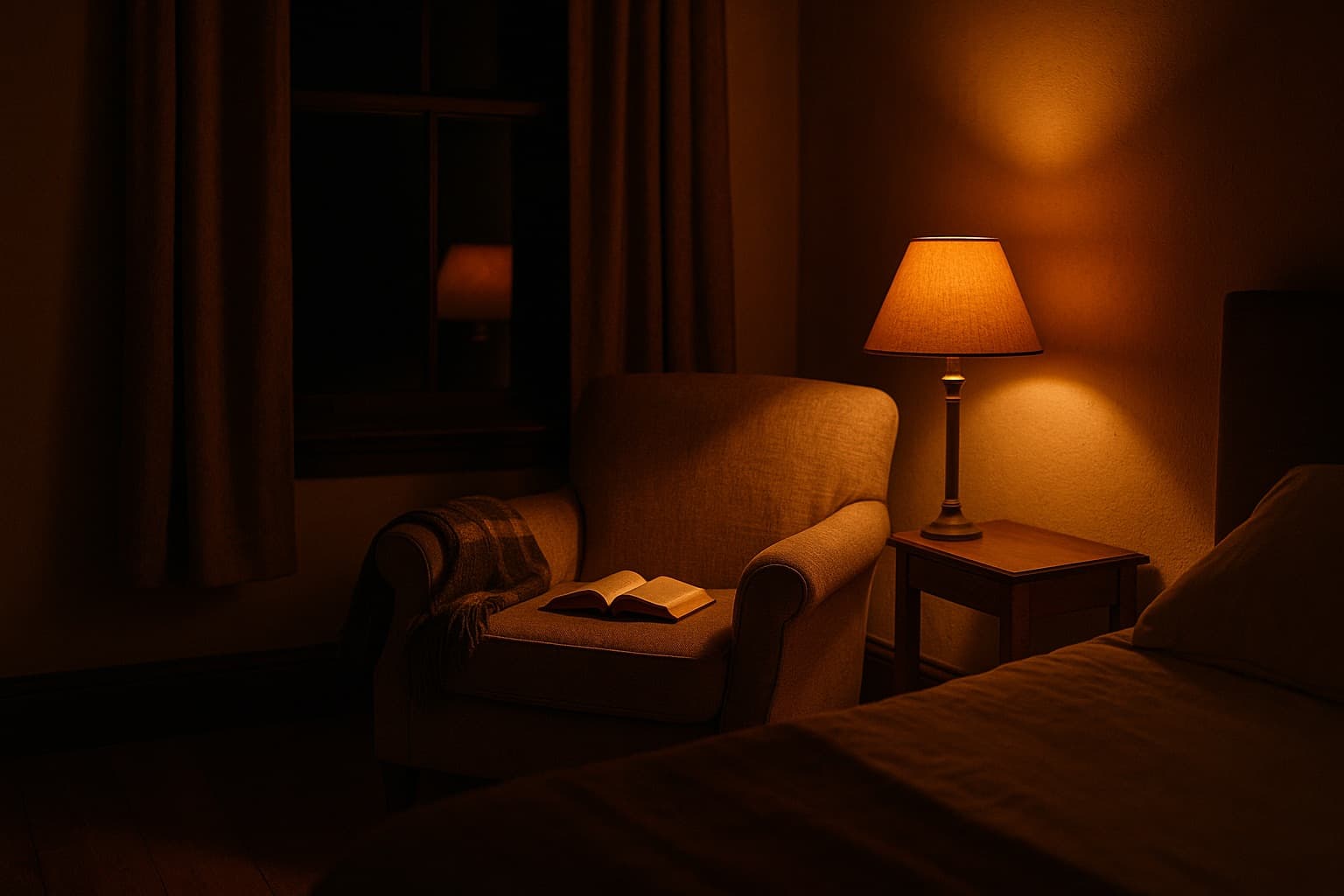
Blue light in the evening is not 'toxic', but it is the strongest signal telling your body clock it is still daytime, which can push your sleep later. To reduce it, dim and warm your lights in the last few hours before bed, keep them below eye level, and cut the blue from your whole-room light, not just your screens. Screen filters like f.lux and Night Shift only change your phone or laptop; the lamps and ceiling lights filling the room are usually the bigger source.
What blue light actually does at night
The light-sensing cells that set your body clock respond most strongly to blue-cyan light around 480nm. In the evening, that light tells your brain 'it is still day', which can delay the natural rise of melatonin, the hormone that signals night to your body, and shift your whole night later. The effect depends on how bright the light is, how blue it is, how long you are under it, and how close to bedtime.
This is normal biology, not a defect, and it is easy to work with once you know the lever.
Why screens are only part of the problem
Phones get the blame, but the lamps, ceiling fixtures and kitchen lights around you often deliver far more light to your eyes than a screen held at arm's length. A blue-light filter on your phone does nothing about the bright white bulb over your head.
That is why the highest-impact fix is the room light itself.
How to reduce blue light in the evening
Three things, in order of impact: dim the light, warm the light, and remove the blue from it. Then handle timing: the last two to three hours before bed matter most.
Blue-blocking glasses can help for your own eyes; screen filters help for screens; a circadian bulb handles the room. Many people combine them.
Ways to cut evening blue light, and what each one covers
| Method | Covers your screen | Covers your room light | Keeps the room usable |
|---|---|---|---|
| f.lux / Night Shift | Yes | No | Yes |
| Blue-blocking glasses | Yes (your eyes) | Yes (your eyes) | Yes, with a tint |
| Warm / dim-to-warm bulb | No | Partly | Yes |
| Turning lights off | No | Yes | No |
| A circadian bulb (spectrally engineered) | No | Yes, blue removed | Yes, stays warm and lit |
Frequently asked
Is blue light really bad for you at night?
It is not harmful in the way that phrase suggests. The concern is timing: blue-cyan light in the evening signals daytime to your body clock and can delay sleep. The same light is helpful in the morning. It is about when, not whether.
Does f.lux or Night Shift actually work?
They work for what they cover, the light coming off your screen, and can help. Their limitation is that they do nothing about the room lighting around you, which is usually the larger source of evening blue light.
How many hours before bed should I avoid blue light?
Roughly the last two to three hours before your target bedtime is when reducing bright and blue light matters most. Earlier in the day, bright blue-rich light is beneficial.
Do blue-light-blocking glasses help you sleep?
Amber or red-tinted glasses that genuinely block short-wavelength light can reduce the blue signal reaching your eyes in the evening. Quality varies widely, and they only help while you are wearing them; they do not change the light in the room for anyone else.
OIO takes the whole-room approach automatically. In the evening it reshapes the bulb's spectrum so almost nothing lands in the 440 to 495nm band your clock reads, while the room still looks like a normal warm white. You get the effect of removing the blue without turning the lights off or wearing tinted glasses.
- CIE S 026:2018. System for Metrology of Optical Radiation for ipRGC-Influenced Responses to Light.
- Brown et al. (2022). Recommendations for daytime, evening and nighttime indoor light exposure. PLOS Biology.
- Berson, Dunn & Takao (2002). Phototransduction by retinal ganglion cells that set the circadian clock. Science.
- WELL Building Standard v2, Feature L03: Circadian Lighting Design.
This guide is general information about light and circadian rhythm, not medical advice. OIO is not a medical device and does not diagnose, treat or cure any condition. If you have a persistent or serious sleep problem, talk to a clinician.